Who Was Victor Mambo Santiago
Victor Mambo Santiago was a Puerto Rican man whose life became known primarily through the stories of his son, rapper and media personality N.O.R.E. Although Victor Santiago never became a conventional public figure, his presence in LeFrak City in Queens, New York, grew into something larger than his official biography could ever capture. To understand him, I have to look beyond formal records and into the memories N.O.R.E. has shared about his childhood, family, neighborhood, and father.
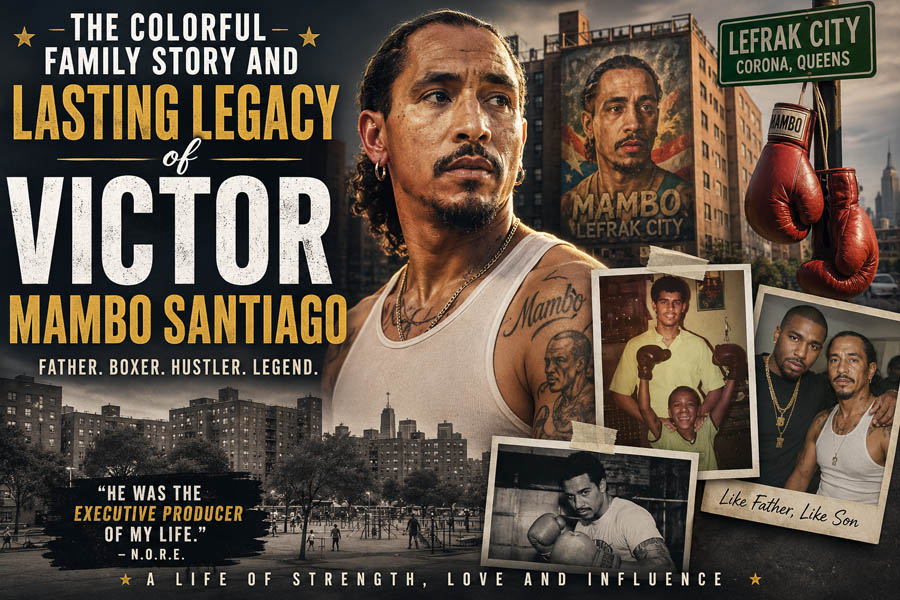
Victor was associated with the LeFrak City housing complex in the Corona section of Queens, where he developed a reputation as a charismatic and tough neighborhood personality. He was known by the nickname Mambo and was also remembered as Poppy. N.O.R.E. has described him as light skinned, with green eyes, a ponytail, earrings, and numerous tattoos. His appearance reportedly made him stand out in a predominantly Black neighborhood, where he was remembered as one of the more recognizable Puerto Rican men on his block.
What makes Victor’s story particularly interesting to me is the contrast between his private family role and his public neighborhood reputation. At home, he was a father who shaped his son’s worldview. In LeFrak City, he was remembered as a boxer, hustler, storyteller, and people person. His reputation became so strong that a mural depicting him reportedly existed in the neighborhood while he was still alive.
Victor Santiago and His Puerto Rican Identity
Victor’s Puerto Rican identity was an important part of his personality and his relationship with his son. N.O.R.E. has spoken about his father’s insistence that he embrace his Puerto Rican heritage fully, even though his appearance could lead strangers to assume something different.
That detail says a great deal about Victor. Identity, in his world, was not merely a label. It was something to stand behind.
Growing up in Queens, N.O.R.E. absorbed that attitude. His father’s experiences reflected the multicultural character of New York City, where race, ethnicity, neighborhood identity, and personal reputation could intersect every day. Victor’s life unfolded within that environment, and his son later carried those experiences into hip hop, interviews, television, and podcasting.
His Life as an Amateur Boxer
Boxing was one of the clearest parts of Victor Mambo Santiago’s identity. He was an amateur boxer who trained and sparred and became known locally for his toughness.
N.O.R.E. has recalled seeing his father around gyms and described him as someone who took boxing seriously. The sport was not simply exercise for Victor. It was part of the culture of his neighborhood and part of the image he projected.
I find the boxing connection especially significant because it continued into N.O.R.E.’s adult life. N.O.R.E. never established a professional boxing career of his own, but he developed a deep appreciation for the sport. He has trained recreationally, worked mitts and bags, followed major fighters, and incorporated boxing into his broader fitness routine.
In that sense, Victor’s influence survived through movement. The son who once watched his father train eventually returned to boxing as an adult, carrying memories of the man who introduced him to the sport.
The Hustler and Neighborhood Personality
Victor’s life was not limited to boxing. N.O.R.E. has portrayed him as a street hustler and a natural people person who knew how to move through the neighborhood and connect with others.
One childhood memory involved Victor selling beers around events such as the Puerto Rican Day Parade and the Queensboro Marathon area. N.O.R.E. was reportedly around 8 years old when he experienced some of these moments with his father.
These stories reveal a side of Victor that formal employment records could never capture. He understood people, crowds, timing, and personality. He was the kind of person who could turn an ordinary street corner into his own small stage.
His reputation also reflected his ability to command attention. The reported mural in LeFrak City became an especially powerful symbol of his local status. N.O.R.E. has remarked that even after becoming famous himself, he did not receive the same kind of mural in the neighborhood that his father had.
Victor’s Relationship With His Son N.O.R.E.
Victor’s son, Victor James Santiago Jr. (N.O.R.E., originally Noreaga), was his greatest legacy.
In Queens, New York, N.O.R.E. was born on September 6, 1977. He eventually formed Capone-N-Noreaga, an influential hip hop duo, before succeeding solo. Songs like “Superthug,” “Nothin’,” and “Oye Mi Canto” made him famous in rap.
However, N.O.R.E. has consistently cited his father as a major influence. He calls Victor his life’s executive producer.
The description is telling. N.O.R.E. says he never wanted to be like famous athletes or entertainers. He wanted to emulate his father.
Victor taught him resilience, confidence, social skills, and survival. Some lessons came from family life, while others mirrored LeFrak City’s harsh surroundings.
The Ice Cream Cone Story
One of the most memorable stories N.O.R.E. has told about his father involves a confrontation between Victor and three men who were allegedly harassing N.O.R.E.’s mother.
According to the story, Victor approached the men carrying ice cream cones as though he were offering a gesture of peace. The situation quickly changed, however, and Victor confronted the men physically.
The story ends with a passerby on a bicycle reportedly calling out, “Yo Mambo stop being a bully.”
Whether viewed as a family legend, a neighborhood memory, or a reflection of Victor’s personality, the story captures the image N.O.R.E. has repeatedly presented of his father. Victor was not necessarily the biggest man in the room, but he was willing to stand his ground.
For me, that is one of the strongest themes in the stories surrounding him. His physical size did not define his presence.
Victoria Holley and N.O.R.E.’s Family
Victor’s partner and the mother of N.O.R.E. was Victoria Holley, an African American woman. N.O.R.E. has spoken about his mother in connection with his childhood and family life, and she later appeared alongside him on the reality television series Love & Hip Hop: Miami.
N.O.R.E. has described his mother as taller and thick in her younger years. Her relationship with Victor formed an important part of the family environment in which N.O.R.E. grew up.
The family lived within the distinctive social world of Queens. Their experiences combined Puerto Rican and African American cultural influences, neighborhood life, family loyalty, and the pressures of growing up in a major American city.
N.O.R.E. has also referred to a sister and at least one other sibling in stories about Victor encouraging his children toward boxing. Their identities and biographies have remained largely private, which makes it difficult to construct a detailed account of the entire family.
Victor’s Other Children and Grandchildren
Although N.O.R.E. became the family’s most visible public figure, Victor was reportedly the father of more than one child. N.O.R.E. has mentioned siblings in various recollections, particularly when discussing his father’s interest in boxing and the activities he encouraged within the family.
The limited public information about Victor’s other children is important because it prevents his story from being reduced entirely to the career of one famous son.
Through N.O.R.E., Victor also became a grandfather. N.O.R.E. has spoken publicly about fatherhood and later family life, although detailed information connecting individual grandchildren directly to Victor is limited.
The family’s private nature has preserved much of their everyday history away from public attention.
Victor’s Death in 1998
Victor Mambo Santiago died of a heart attack in 1998. N.O.R.E. has specifically identified July 3, 1998, as the date of his father’s death.
The timing was devastating. N.O.R.E.’s debut solo album, N.O.R.E., was released in July 1998, placing his father’s death around the same period as a major turning point in his professional life.
For a young artist beginning to establish himself, losing the person he regarded as his primary role model created an emotional rupture. N.O.R.E. has spoken about the pain associated with his father’s death and about how that loss influenced his later life.
After Victor died, Chris Lighty, N.O.R.E.’s manager during that period, reportedly became something of a father figure to him. That relationship helped provide support during a period when N.O.R.E. was navigating the demands of fame and the absence of his father.
How Victor Influenced N.O.R.E.’s Boxing and Fitness Journey
Victor’s influence did not disappear in 1998. In some ways, it became more visible as N.O.R.E. grew older.
N.O.R.E. has explained that after his father’s death he fell deeply in love with boxing. The sport became more than a childhood memory. It became a way of reconnecting with something Victor had loved.
N.O.R.E. has also discussed his father’s interest in running and physical activity. Interestingly, N.O.R.E. has said that while his father was alive, he did not necessarily appreciate those activities. Later, he embraced running, marathon culture, boxing, and fitness himself.
His modern wellness lifestyle includes boxing workouts, running, strength training, and other forms of conditioning. He has spoken about training with professional fighters and has expressed admiration for figures such as Mike Tyson, Danny Garcia, Floyd Mayweather, and other boxing personalities.
There is no evidence that N.O.R.E. became a professional boxer or accumulated an official competitive record. His connection to boxing is better understood as a lifelong passion inherited from his father.
The Family Legacy in Queens
Victor Mambo Santiago’s legacy remains closely tied to Queens. His story belongs to a particular generation of New York neighborhood characters whose influence was often measured not through awards or official titles but through recognition from the people around them.
LeFrak City was more than a backdrop to Victor’s life. It was part of the family mythology that N.O.R.E. carried into his music and later conversations.
The mural associated with Victor is perhaps the clearest symbol of that reputation. A mural can turn a person into a landmark. It says that someone mattered enough to become part of the physical memory of a neighborhood.
N.O.R.E.’s later success added another layer to that legacy. His father became part of the story behind a rapper, entrepreneur, television personality, and podcast host who eventually reached audiences far beyond Queens.
N.O.R.E. and the Continuing Memory of His Father
N.O.R.E. still discusses Victor decades after his death. Boxing, neighbourhood stories, family lessons, Puerto Rican identity, fitness, and loss are among his memories.
His podcast career, especially Drink Champs, has provided him a unique platform to preserve these experiences. Stories that would have slipped into family talks are now part of culture.
I guess that’s why Victor Mambo Santiago is intriguing despite his low formal information. No celebrity biography covered his life. It lives on in remembrance.
His son recalls the green eyes, tattoos, ponytail, boxing gloves, neighbourhood notoriety, family arguments, toughness teachings, and countless other Queens childhood events.
These memories paint a vivid but incomplete portrayal.
Frequently Asked Questions
Who was Victor Mambo Santiago?
Victor Mambo Santiago was a Puerto Rican man from the LeFrak City community in Queens, New York, and the father of rapper and podcaster N.O.R.E. He was known locally as an amateur boxer, hustler, and charismatic neighborhood personality.
When did Victor Mambo Santiago die?
Victor Mambo Santiago died in 1998 from a heart attack. N.O.R.E. has identified July 3, 1998, as the date of his father’s death.
Who was Victor Mambo Santiago’s famous son?
His son was Victor James Santiago Jr., professionally known as N.O.R.E. and Noreaga. Born September 6, 1977, N.O.R.E. became known through Capone-N-Noreaga, his solo music career, and later the Drink Champs podcast.
Was Victor Mambo Santiago a professional boxer?
No. Victor was known as an amateur boxer who trained and sparred. There is no widely documented professional boxing record associated with him.
Did N.O.R.E. become a professional boxer?
No. N.O.R.E. has a strong personal connection to boxing, but his boxing involvement has been recreational and fitness oriented rather than a professional competitive career.
Who was N.O.R.E.’s mother?
N.O.R.E.’s mother was Victoria Holley, an African American woman who has appeared publicly with her son, including on Love & Hip Hop: Miami.
How did Victor Santiago influence N.O.R.E.?
Victor influenced N.O.R.E. through boxing, neighborhood experience, Puerto Rican identity, personal toughness, social skills, and family values. N.O.R.E. has repeatedly described his father as his primary role model.
Did Victor Mambo Santiago have other children?
N.O.R.E. has mentioned a sister and at least one other sibling, but detailed public information about Victor’s other children remains limited.
Did Victor Mambo Santiago have grandchildren?
Yes. Through N.O.R.E. and potentially his other children, Victor became a grandfather. Detailed public information about his grandchildren is limited.
Why is Victor Mambo Santiago remembered today?
Victor is remembered primarily because of the lasting influence he had on N.O.R.E. His reputation as an amateur boxer and neighborhood figure, his reported mural in LeFrak City, his Puerto Rican identity, and the stories his son continues to tell have preserved his memory long after his death.